
June 2026
Version 3.33.2
Released on June 16th, 2026
✨ New Feature & Enhancements
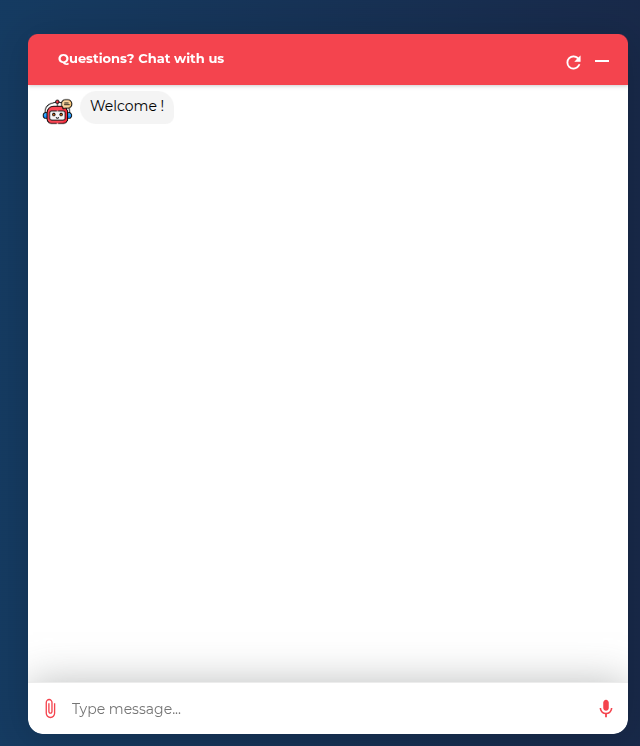
- New: Webchat File Upload Support
Addition of file attachment capabilities within the Webchat widget. Users can now upload documents directly through the chat interface. A new toggle has been added to the Webchat integration settings to enable or disable this feature per bot.
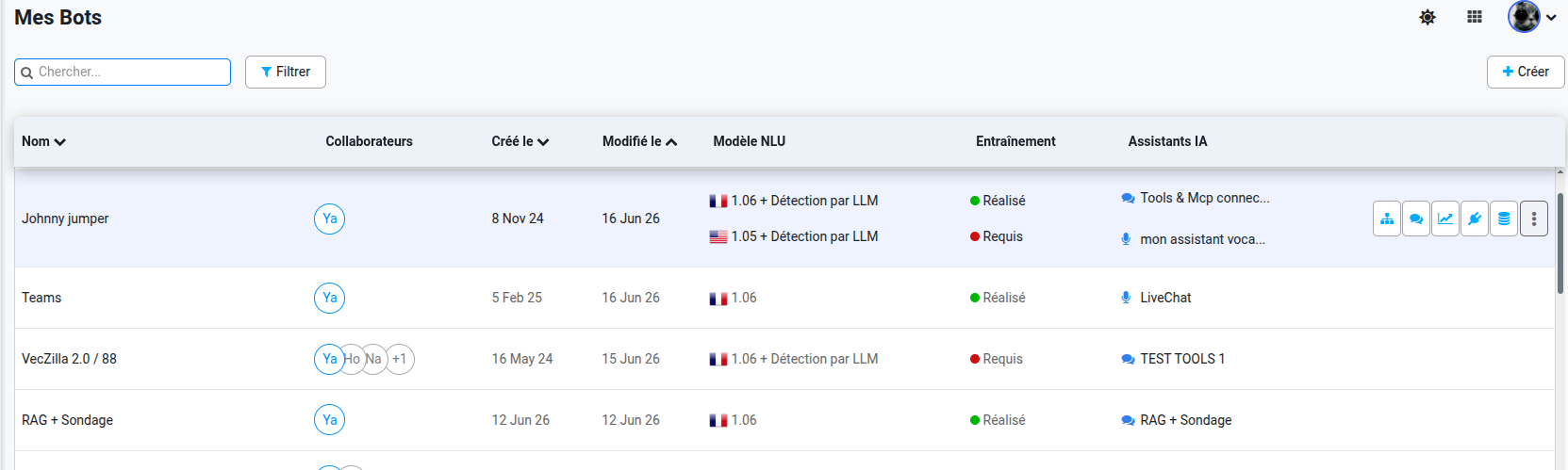
- Improved: AI Assistant Visibility in "My Bots" List
The main bot dashboard now includes a dedicated column for AI Assistants. Specific icons have been integrated to clearly distinguish between Chat-based and Voice-based (Callbot) assistants
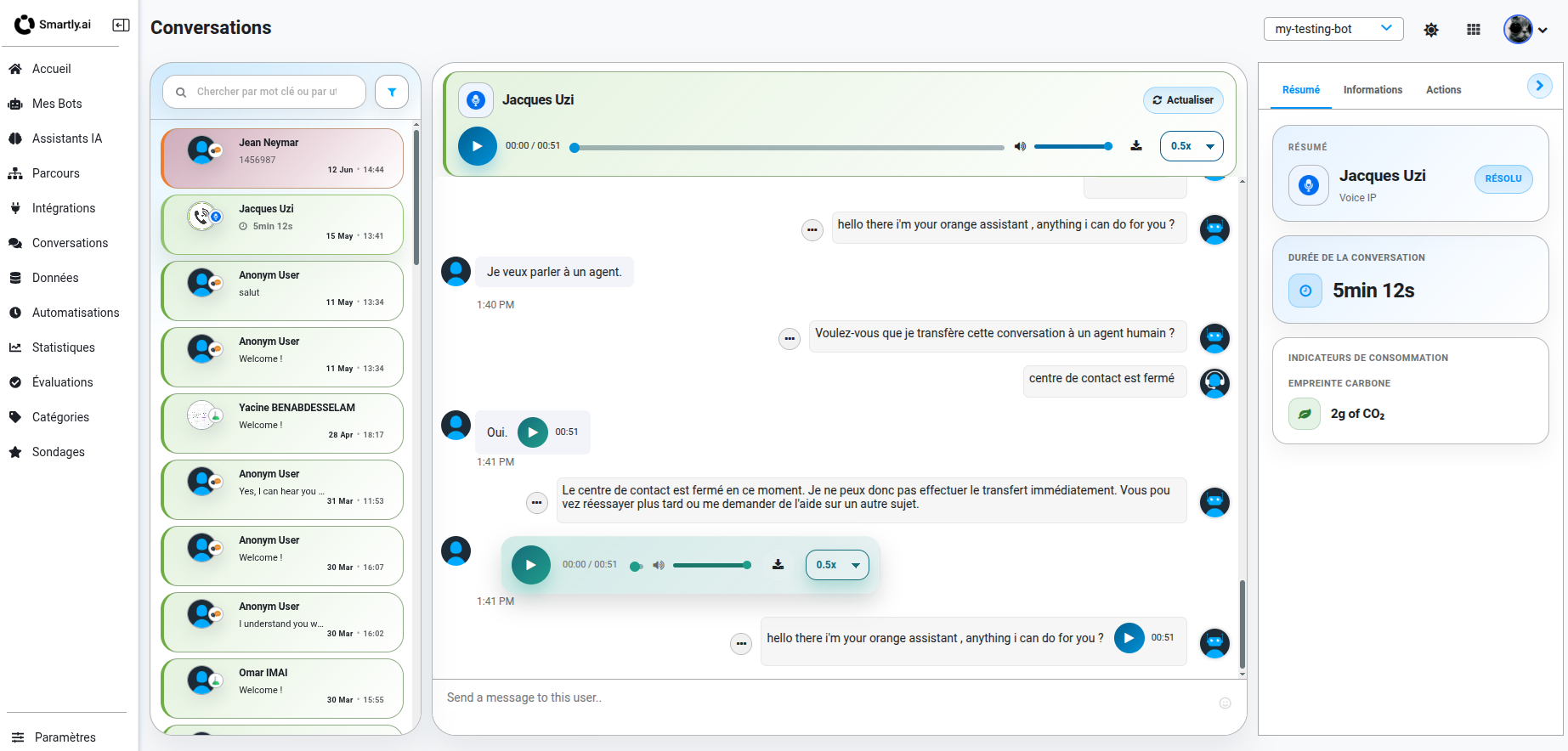
- Improved: Front-End Redesign of the Conversation Module
Major UI/UX refresh of the Conversations interface to enhance readability and monitoring. The update includes a cleaner message layout and optimized synchronization for vocal interactions, allowing users to listen to audio logs and view transcriptions simultaneously.
🛡️ Platform & Engine Reliability
- Improved: LLM Proxy Robustness & Error Reporting
Improved communication between the platform and the LLM Proxy for better information retrieval. The system now handles specific error codes:
-
471: Too many requests per minute.
-
472: Too many tokens per minute.
-
473: Budget exceeded.
-
474: Model unavailable.
-
479: Platform unavailable.
- Improved: Activity History Tracking for Node.js Scripts
Enhancement of the activity history management for Node.js executions. This update improves the logging and tracking of custom functions.
🐞 Bug Fixes
Fixed: Language Switching in Voice Chat Sessions
Resolution of a bug where the vocal assistant failed to switch between configured languages (e.g., from French to Arabic) during an active session. The engine now correctly detects and adapts the response language based on user speech, regardless of the initial session language.
Other changes
Removal of Tutogenius Integration
Decommissioning and removal of the Tutogenius integration from the platform's available infrastructure.
Version 3.33.1
Released on June 1st, 2026
🛡️ Platform & Engine Reliability
1. New: Redis Caching for NLU Queries
Implementation of a Redis-based caching mechanism for NLU (Natural Language Understanding) requests. This optimization prevents the redundant processing of identical user inputs within a defined timeframe, significantly reducing server load and improving overall response latency.
i. Standard TTL: A default 60-second Time-To-Live ensures that bot updates and re-trainings are reflected quickly.
ii. Custom TTL: Higher execution-cost queries can be assigned a longer TTL to further optimize performance.
2. Improved: Real-Time LLM Support for Callbots
Integration of the Real-Time API mode (available via LLM Proxy) within the Callbot infrastructure.
3. New: Advanced Input Filtering Layer for NLU
Addition of a pre-processing filtering layer for user inputs sent to the NLU engine to prevent service instability. This system identifies and cleanses problematic data, including:
-
Non-linguistic characters and invisible Unicode symbols (e.g., zero-width spaces).
-
IP addresses and excessive numerical tokens (e.g., long lists of codes or numbers).
-
Repetitive punctuation (e.g., "!!!!!!") and excessive word duplications (e.g., "bonjour bonjour bonjour").
-
Abnormally long tokens.
-
Comprehensive Emoji Management: Detection of all emojis with automated replacement by their text equivalents or removal.
-
Technical Text Protection: Specialized logic to handle inputs like "4G" or "5G" ensuring they are preserved and not incorrectly filtered during emoji processing.
✨ New Feature & Enhancements
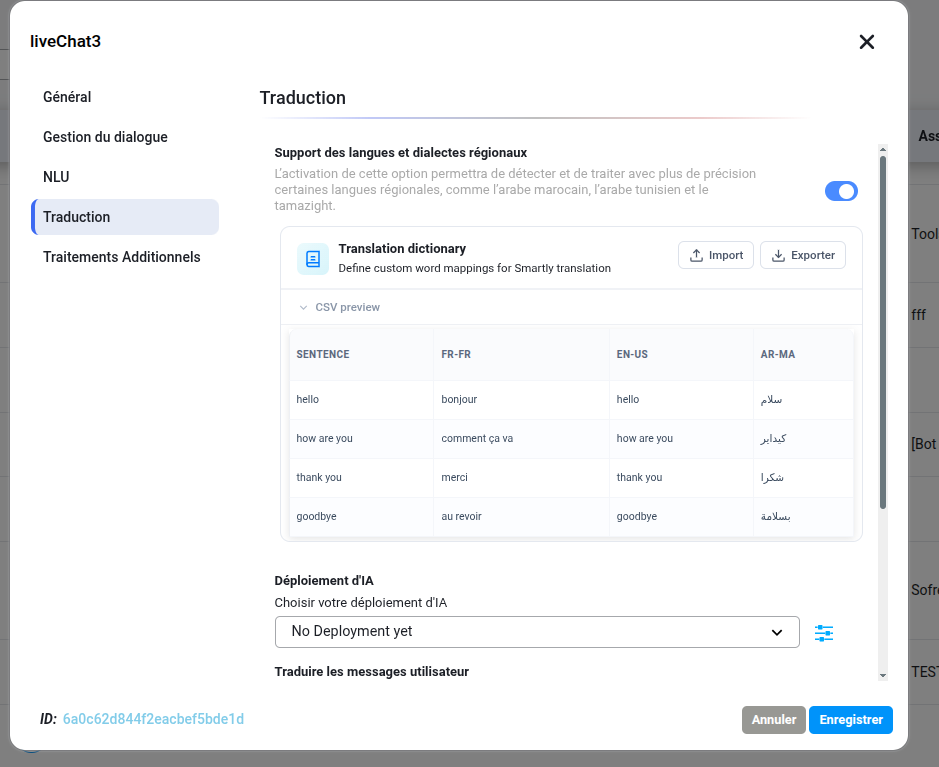
- New: Multilingual CSV Support for Translation Dictionary
Support for the CSV format within the translation dictionary, allowing for the configuration of translations across multiple languages in a single file. An integrated CSV preview has been added to the interface to display the sentence mappings for each locale (e.g., FR-FR, EN-US, AR-MA).